Friday, November 28, 2014

Aztecs

I have heard that the Aztec capital--Tenochtitlan, located in present day Mexico City, more or less--was one of the world's biggest cities in 1500, just before the Spaniards arrived. According to the Wikipedia, "With an estimated population between 200,000 and 300,000, many [who?] scholars believe Tenochtitlan to have been among the largest cities in the world at that time. Compared to Europe, only Paris, Venice and Constantinople might have rivaled it."

Logic implies that the Aztec civilization, therefore, most have been one of the most complex an organized in the world. After all, it take a lot of food to support that many people, which requires some form of infrastructure and administration to ensure that the food made it from the countryside to the city. With no draft animals to pull plows or carts, (or ride around on), the number of humans who had to coordinate to grow and transport that much food was probably higher than in Europe. As for the city itself, most of the people there probably weren't priests or rulers, but artisans or administrators of some sort--implying a substantial (for the age) middle class of skilled people.

All of which implies a pretty darn complex civilization.

About which I know virtually nothing.

Compare to ancient Rome: I learned Latin in highschool, can name most of the major Roman deities off the top of my head, and can sketch a vague outline of Roman history and culture.

At the very least, this implies that there's a lot of interesting stuff for me to learn.

Sunday, November 23, 2014

Just Published #2: Friends and Foes, a Memoir

Today's interviewee is Jim Williams, author of Friends and Foes, a memoir about his battle with homelessness and schizophrenia.

I particularly recommend this book to anyone working with the poor, the homeless, the downtrodden, or the mentally ill, (or anyone who intends on working with them.) I recommend it for people whose loved ones are facing such difficulties, and of course, I recommend it for people suffering such difficulties themselves.

Thank you, Mr. Williams, for joining us today.

Why don't you start by telling us a little more about your memoir?

On my way home to camping in Golden Gate Park, unknown assailants bludgeoned me into a coma and left me to die. Two years later, as I was being diagnosed by my physician for mental illness, my friend offered his silence while the doctor examined me. My case for being in reality would have been stronger if my friend had existed.

I slept inside discarded rolls of carpet to get out of the rain. Professional caregivers openly mocked my failings. Security guards ousted me from benches at three in the morning, and I sobbed alone in the darkness. I participated in dialogues with illusory voices, and we formed a World Government. Amidst day-to-day functioning on the streets, my unreal friends and I anticipated the day our telepathic leaders would end warfare and run the planet.

Finally, with detox and therapy, real voices began to replace my auditory hallucinations. Friendships developed while I realized people do still care about people. Reuniting with my brother, I started this book, detailing my 15 homeless years and struggles with hearing voices and psychosis.

FRIENDS AND FOES is a memoir complete at 45,000 words. My story shatters stigmas and provides hope.

What inspired you to write about your experiences?

My outrage at the severity of the assault. No matter what I haven't accomplished in my life, the assault was too much for anyone need endure. I couldn't just absorb it alone.

What was the hardest part of your story to write?

Anything to do with my failings to my children. I had a daughter that died when she was four and a son I'll probably never know. I got to email the son a reference to my book, but I don't know if he'll pick it up.

If you could change the way society treats the homeless and/or mentally ill, what would you change?

For "professional caregivers" to realize how competent street people have to be to survive. Yes there's help, but all needs, whether hygiene, shelter or food, must be met by street people on their own. Doing so takes effort and competence not always recognized.

And if you could give one message to other people struggling with homelessness and/or mental illness, what would it be?

Life, at least DNA based life, universally wants to live and thrive. Find that part of yourself that also wants to live and thrive, and follow it. In other words, be yourself.

Tell us a little about yourself. What are you reading these days?

Time magazine because I have a subscription.

What's your favorite kind of coffee?

Peet's.

What are you working on, now? Do you have a new project?

Designing a painter's easel that will stand in the sand.

All right! Thank you so much for joining us today, and good luck!

Wednesday, November 19, 2014

Just Published #1: Things Grak Hates, by Peter J. Story

Today's interviewee is Peter J. Story, the auspiciously named author of THINGS GRAK HATES, a darkly funny and occasionally horrifying tale about a man who hates olives and the depths of sociopathy. You can follow Mr. Story on his Facebook or his blog, or probably practically any social media platform you prefer.

I stumbled upon Things Grak Hates mostly by chance back during its drafting stages, read a few excerpts, and decided this was a book worth following. And now I have finally had a chance to read the whole thing, and yes, I think it is a fantastic, 5-star book.

Thank you, Mr. Story, for journeying all the way to Elflandia. So, tell us about your novel. What was the hardest part of the story to write?

Limiting the scope of my writing has always been the most difficult thing for me, as I think it is for many writers. I have a tendency to run away with a story and its characters, but that would have broken the rules I defined in my outline. Namely, the pace had to be slow, and the build-up had to be gradual. Another very important, but limiting element was that everything is seen through Grak's eyes, so he only notices the world and those around him when they threaten his desires. Those rules were all crucial to both style and story, but meant taking some very deep breaths when I sat down to write.

What motivates Brak? What motivates the others?

When the story opens, everyone is motivated by habit and naivete more than anything. The supporting characters all begin with a very simple and peaceful set of habits, reflecting their simple, peaceful way of life and establishing a clear comparison to the tribe we see at the end of the novel.

Brak cares about others, yet is a bit of a pushover, partially because of self-image issues. Jafra has always had quite a bit of strength as a matter of necessity--because Grak has grown up rather spoiled, her proximity to him has made her more responsible than might normally occur. Doran is accepting (perhaps to a fault) and a dreamer. Even Grak is motivated by habit, though his habit is self-absorption.

As the tale develops, each character's motivations develop in direct relation to Grak's actions, thus showing a bit more of their true tendencies. Their decisions aren't dictated by unalterable personality traits so much as by sheer force of habit. Thus, they follow their tendencies along the path of least resistance to form the characters we see by the end of the book. Except, of course, for the handful of brave souls willing to go against the grain.

Why hunter-gatherers? And why tyrants?

The nomad choice was basic enough. It seems to be one of the most uncluttered and rhythmic ways of life, which is exactly what's needed to show a drastic shift in the dynamic of a community. And it gave me room to slow the story's pace down enough to give proper focus to Grak's descent.

The tyrant aspect of "Things Grak Hates" just followed naturally from Grak's character. Left to our own devices, I think it’s easy for anyone to become a tyrant of sorts. Most of us have witnessed the likes of a new middle manager in the organization. A person who gains the slightest bit of power, but thinks they've arrived at some promised land. The difference is that their power has natural limits. With "Things Grak Hates," I'm asserting that this hint of megalomania is the same drive behind the tyrants and dictators of history. They crave that control, and they'll do anything to achieve it.

Some of us are less inclined to this trait than others, but ultimately, we are all selfish beings. The natural progression of an undeterred selfish soul ultimately ends with some sort of tyranny. Some are merely tyrants over their immediate circle of friends and family. Others rule tyrannically over their peers and employees. Dictatorships aren't so different--they're just ruled by a tyrant on a much larger scale.

So, without giving away the ending, how much do you agree with it? (You readers will just have to read the book to figure out what we mean.)

That's difficult to answer without giving anything away. Obviously, I don't agree with Grak's behavior. That's the main point of this book. But I do agree with the concept of redemption. Truly. But does Grak deserve redemption? Does any tyrant? Does anyone? Where do we draw the line? More importantly, would redemption be so sweet if it were deserved? Would it fill us with such hope?

In the end, I'm not Grak's judge, so I've left that question open. But like the rest of this book, I think that answer will be different for each person. It all depends on your particular set of experiences, your current focus on life, and the goals you've laid out for yourself. Which side of Grak are you looking at? I've been encouraged by the myriad of reviews that have applauded so many different angles of the story. That's what I was aiming for: to tell a tale with many facets and new meaning from each reading.

Tell us a little about yourself. What are you reading these days?

Most recently, I've been working through an alpha version of book two of "The Last Bucelarii" by Andy Peloquin. It's a dark fantasy series from an incredible new author. The first book is coming out in the next few months. It's kind of fun to read alpha copies, but also somewhat sad. I get to read it first, but since I almost never read a book twice, I don't get to read the final version. But Andy has an intimate relationship with his words, so his alpha versions are actually better than many other completed books that I've read.

Where did you grow up?

I grew up in San Antonio, Texas, and have lived here for much of my life. I find it a charming place. People here are generally quite friendly, and the pace is rather slow for such a large city. Plus, there's a lot of history here, which is precious to me.

What's your favorite kind of coffee?

I use a pour-over coffee brewer at home. People complain that pour-over coffee takes a lot longer to brew, but the flavor is surprisingly better than coffee from a machine. I take it with a little cream, no sugar, a pinch of cinnamon, and a few drops of vanilla. Beyond that, I really have no preference.

What are you working on, now? Do you have a sequel planned, or something new?

It's something new. Very different from Grak in many respects. I'm working on the outline in the spare moments I have while promoting "Things Grak Hates." I'm very particular about my stories, and if something doesn't flesh out into a full story, I won't push it. I'll even scrap a story or put it back on the shelf for later if I don't like it. Because of that, I'm trying to finish the outline before I give away any details.

It's my observation that books seem to reflect their writers. What aspect of you is reflected in your book?

A great deal. More than I even intended. Much of my younger life, I was a bit of a Brak. In fact, other than the fact that he's bald, I think he and young me have a great deal in common. Doran's ability to live on a dream and get completely absorbed by it was also me. Jafra was based mostly on the strong women I've known in my life, but that same willingness to speak the truth through fear was something I drew from my own experiences.

And then there's Grak. I have some OCD tendencies, so I injected that into his character. Also my eyesight is weak, so when I considered putting that in, it clicked with Grak's limited view of the world around him, and I just had to do it. And I've been the young middle-manager I spoke of earlier, so I know firsthand that the desire for control can be addictive. But most of all, I drew on my own fears and pain for Grak. Of course, I had to follow them into new territory, but I'd like to think that if I had clung as tightly to myself as Grak did and rejected the people around me who cared, I could have gone down a darker path. It's sobering.

Would you like to leave us with a quote from your book?

I have such a hard time making decisions like this, but someone recently posted a quote on their Tumblr feed and it's definitely one of my favorites.

“Sometimes life just … happens. And sometimes it hurts, and we can’t stop it. We can’t control it, no matter how hard we try. And that hurts even more.”

Thanks for everything!

Thursday, September 25, 2014

Clips from the Cutting Room Floor

"He brushed the snow from a stand of Queen Anne's Lace, then bent the flowers' stems to show them to her. "See how they branch, time and again, each according to the same pattern?"

Lyta came timidly beside him. She took one of the dried pods and carefully opened it, revealing last summer's blooms. "Each flower is a thousand white ones, but at their center lies a tiny red, a flower within a flower, the whole contained within itself." She held it out to him, and their fingers brushed as he accepted it.

"Nature has such an extravagance of beauty that she must put flowers within flowers," he said, but his eyes never left hers, and she felt as though he weren't talking about plants at all."

Tuesday, September 16, 2014

The French Revolution, Calvinist Rabbis, and the Little Ice Age

In my Further Explorations of History, I was recently reading about the teachings of some Eastern European Rabbis from the 1700s (a dismal time for Jews due to persecution,) and the fire-and-brimstone approach of "You slackers need to fast and pray more!" reminded me rather strongly of similar attitudes among Calvinist and other protestant preachers. (For the record, this line of thinking appears to have been later rejected in Judaism, by teachers like the Baal Shem Tov, so it should not be taken as indicating anything about modern Jewish thought.)

Then I recalled that this was also about the time of the French Revolution (late 1700s), which I ascribe largely to the effects of a particular nadir in the Little Ice Age. (I had a post about that a while back with graphs.) A bad hail storm also happened to wipe out a large % of France's crops right before the French Revolution kicked off--when a few years of bad harvests have completely depleted your savings, and then a hail storm destroys the harvest, your attitude towards paying taxes will turn distinctly sour. You might even behead a monarch or two and try to redistribute all of the land in a desperate attempt to not starve.

I wouldn't be surprised if similarly bad weather over in Eastern Europe prompted both increased antisemitism and gloominess--I know I'd feel pretty depressed if my crops failed and then someone burned down my house.

Another nadir in the Little Ice Age occurred in the 1600s. I don't know the history of the 1600s well enough to speak intelligently about it, but I speculate that this nadir was responsible for the English Civil War and the triumph of ultra-depressing Puritanism in England during that period.

I further speculate that multi-year crop failures (or single-year mega-calamities) ought to be strongly tied to religious pessimism and political revolutions/rebellions in a way that historians could probably even quantify and make predictions with. An end to the lean times ought to promote the emergence of more cheerful philosophies, politics, or religious teachings.

Saturday, May 31, 2014

Art Post: Niko Pirosmani

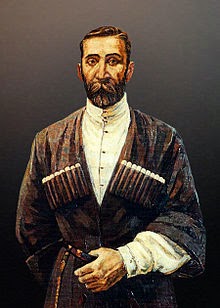
Nikoloz Aslanis Dze Pirosmanashvili, or Niko Pirosmani, was a self-taught Georgian painter (from the Georgia that's a nation in the Caucuses, not the Georgia that's part of the US,) who lived from 1862 to 1918. He must have truly loved to paint, for he lived most of his life in utter obscurity, trading his paintings for food and shelter. He was "discovered" by the art world only toward the end of his life, and doesn't seem to have really understood what all of that fuss and bother meant. Poor Niko got sick, and with no one to look after him, soon died.

Today, Pirosmani's art is well-respected in his homeland, and he graces the Georgian 1 Lari bill:

For more information on Porosmani, I recommend his biography on Olga's Gallery (an art website,) his Wikipedia Page, or Soviet Life Magazine, 1969. (Why was I reading Soviet Life? Research.)

Anyway, here are some of his paintings I enjoyed:

A Boy Carrying Food

Threshing Yard, Evening

Cook

Gate Keeper

Feast in a Gazebo

Shepherd in a Sheepskin Coat on a Red Background

Tatar--Camel Driver

Train in Kakhetia

Donkey Bridge

Signboard: Wine Pub

Party by the River Zkheniszkali

Kakhetia Sagas, Alazan Valley

Kakhetia Sagas, Alazan Valley, detail

Kakhetia Sagas, Alazan Valley, detail

Batumi

Hunting Scene with a View of the Black Sea

The Tiflis Funicular

Prayer in a Village

Robber with a Stolen Horse

Wedding in the Old-Time Georgia

Grape Harvest Feast

Shamil with a Bodyguard

Shepherd with Flock

More of Pirosmani's paintings.

Back to the Fabulous Eurasian Steppes!

The pink part marks the steppes. The red lines mark the borders of "Europe," which is, obviously, not really a continent, but whatever we happen to feel like calling "Europe." Same goes, of course, for "Asia." Interestingly, a rather large % of Europe is steppe, though you don't hear much about it except in the context of "barbarian hoards boiling out of the steppe and threatening the walls of Europe," as though Europe started where the steppes end. Rather, the steppes lead right into the heart of Europe, like taking the Eurostar from France to London.

Physically, the steppes are largely flat and grassy. People have moved across them, often on horseback, for thousands of years. Much of the world's population is at least partially descended from steppe folks. 1 in 200 people today are thought to be descendents of the steppes' most famous warrior, Genghis Khan (and his immediate family, most likely.)

This post is mostly a random assortment of information I happen to have recently come across about various steppe peoples. I don't claim to be complete, extensive, authoritative, or even in chronological order. There are probably many large groups about which I know virtually nothing, and small groups about which I know comparatively a great deal.

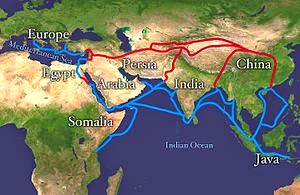
One thing I noticed while looking at this first map is that the fabled (but very real) Silk Roads of Asia run well to the south of the steppes:

The Silk Roads (water routes excluded) go through some very rough terrain, like mountains and deserts. The steppes, while often cold, are nothing if not flat and easy to cross. Their under-utilization as a trade highway has probably been due to most of the goods people wanted to trade for coming from areas well to the south of the steppes, like the Iranian, Harappan, and Chinese civilizations. The steppes are not particularly known for their small, easily transported, valuable trade goods. This is not to say that trade did not cross the steppes, only that the steppes and the Silk Road are different.

Here's another fun map, of the Great Wall of China:

China has had, shall we say, an historical issue with getting invaded by the Mongols. I don't know if the walls particularly worked, but they certainly tried. (Those medium-purple wall sections up in the north were built by Chinese dynasties that were, apparently, ruled by Mongolian tribes from up that way. I'm not sure how that all works out in the nationalist rhetoric, if they should be properly considered part of the Great Wall complex, or an inter-Mongol defensive work, but they all do serve the same purpose.)

A map of Eurasia before the mongol conquest:

Another map of roughly the same period (they disagree on some points):

And after the Mongol conquest:

A lot of people died in between those maps.

Somewhere around 1280, a fellow named Rabban Bar Sauma, a Nestorian Christian born near Beijing to a perhaps Turkic or Uighir family, became an ambassador for the Mongol Empire and eventually made it to the Atlantic coat of France before heading back:

The parallel to Marco Polo is obvious, and indeed, he wrote a boo about his adventures, titled "The Monks of Kublai Khan, Emperor of China" or "The History of the Life and Travels of Rabban Sawma, Envoy and Plenipotentiary of the Mongol Khans to the Kings of Europe, and Markos Who as Mar Yahbh-Allaha III Became Patriarch of the Church of the East in Asia," which was translated by Sir E. A. Wallis Budge and published in English 1928... which means it might be in the public domain, depending on technicalities. Anyway, the Khan of the Mongols, Arghun, wanted to arrange an alliance with the French to conquer the Middle East together. Here's an excerpt of one of the letters he sent, which happens to mention Rabban:

According to the Wikipedia, the letter says,
"Under the power of the eternal sky, the message of the great king, Arghun, to the king of France..., said: I have accepted the word that you forwarded by the messengers under Saymer Sagura (Bar Sauma), saying that if the warriors of Il Khaan invade Egypt you would support them. We would also lend our support by going there at the end of the Tiger year’s winter [1290], worshiping the sky, and settle in Damascus in the early spring [1291].

If you send your warriors as promised and conquer Egypt, worshiping the sky, then I shall give you Jerusalem. If any of our warriors arrive later than arranged, all will be futile and no one will benefit. If you care to please give me your impressions, and I would also be very willing to accept any samples of French opulence that you care to burden your messengers with..."

Nothing much came of the alliance, as France did not seem as keen at the time on conquering the world as the Mongols--plus Arghun died before anything got done.

More later on people who weren't the Mongols...

(All maps and the letter in this post courtesy of the wonderful and fabulous Wikipedia.)

Thursday, January 30, 2014

Jasper Teaches Lyta to Make Fire

I thought this was a cute little scene, but it doesn't fit where I had it. Perhaps it will find its way back in elsewhere.

"I should teach you to build a fire," said Jasper.

"I know how to build a fire," said Lyta, bristling. "You use matches -- "

"No, a real fire." Jasper picked up a twig, and a flame sparked from the end like a little candle. "Do you see? The fire has a soul."

Lyta frowned. It just looked like fire to her.

He waved a hand over the twig, and the flame disappeared. "Cup your hand around the wood." He bent her fingers into position, his skin warm. "Feel the the energy within it. Then reorder it to match the fire's soul." His breath tickled her ear as magic flowed through her hand. Her skin tingled, then burned.

Lyta squeaked and pulled away as a flame burst out of the kindling. She rubbed her hand. "Is it supposed to hurt?"

"A little fire only burns a little. Now you try," said Jasper, nudging her hand back toward the pile.

Lyta bit her lip, held her hand over a twig, and tried her very best to make the twig feel like it was on fire.

It remained unburnt.

Jasper waved his hand over the pile and it burst into flames. "I suppose I should have one thing I'm good at."

Monday, December 16, 2013

Future Published #4: The Bride Gift

Today's interviewee is Sarah Hegger, author of THE BRIDE GIFT. You can follow Mrs. Hegger on her Facebook, Twitter, or her blog. In this case I must confess that I am cheating, because I happen to know that the novel has been sold to Soul Mate Publishing and will be out in May, 2014. Thank you, Mrs. Hegger, for journeying all the way to Elflandia.

Mrs. Hegger: Thanks for letting me drop by.

So, tell us about your novel. What inspired you to write this story?

Mrs. Hegger: I have always been interested in the role of women and specifically the power, or lack thereof, they have had over the centuries. Even in times when women were the most powerless, there have been those that stood out. Empress Maude, Eleanor of Aquitaine, Elizabeth l, Victoria and so many more. I wanted to write a story where a woman was powerless and how she worked within the system to get what she wanted.

Who was your favorite character to write?

Mrs. Hegger: My hero Guy of Helston. I set myself a tough task with him. I didn't want to pretty him up, but keep him pretty much your basic medieval fighting machine. Guy is so non-verbal that I had to find inventive ways of getting him to 'speak' and still keep him to growls, grunts and monosyllabic responses.

What motivates your characters?

Mrs. Hegger: In essence, both Helena and Guy are motivated by security. They want to secure their futures. Both of them have been at the mercy of others and are determined never to be in that position again.

Why Medieval England?

Mrs. Hegger: Castles, horses, those lovely bliauts. And I also don't think I ever recovered from seeing the old Richard Harris/Vanessa Redgrave version of Camelot.

Do you ever kill characters? (You don't have to answer that!)

Mrs. Hegger: Oh, yes. This is bad Olde England after all, but I'm not going to give anything more away.

Tell us a little about yourself. What are you reading these days?

Mrs. Hegger: I am a voracious romance reader. I always have one or two on the go. Which is probably why I can never get the titles straight. I never miss a Kristan Higgins or a Jill Shalvis. I love Eileen Dreyer, Madeline Hunter and Lisa Kleypas. I have just finished reading Wounded Wings by Shauna Allen. I managed to get lucky enough to get my hands on an advanced copy.

Where did you grow up?

Mrs. Hegger: I was born in England, but spent most of my life in South Africa. I just mourned, with my country men and women, the death of the incredible Nelson Mandela.

What's your favorite kind of coffee?

Mrs. Hegger: For some reason, since my pregnancies (many moons ago) I can't take strong coffee anymore, but I still love it. I compromise with a Venti Non-Fat Latte every morning

What are you working on, now? Do you have a sequel planned, or something new?

Mrs. Hegger: I am just putting the finishing touches to a new medieval called "Sweet Bea." It's set in King John's England in the year 1215 and I have taken a huge chance and made my hero a thoroughly unlikeable SOB for the front part of the book. He gets better, though, and by the end of it, is as lovely and dreamy as any other romance hero. (This is my hope, anyway). I have also just started a new contemporary and am experimenting with the idea of perfect that we women can get so tangled in.

It's my observation that books seem to reflect their writers. What aspect of you is reflected in your book?

Mrs. Hegger: Hmmm - now you've got me thinking. Probably the fact that most of me heroines present as tough, but they are masks to conceal a softer inside. Actually, a lot of my heroes do the same thing. I like to play around with the ideas of strength and vulnerability and how closely they are tied together.

Would you like to leave us with a quote from your book?

The blurb: 1153, in the period dubbed ‘The Anarchy’, King Stephen and Empress Maud are not the only ones embroiled in a fierce battle of the sexes.

Determined to control her own destiny, willful Helena of Lystanwold has chosen just the husband to suit her purposes. But, when her banished guardian uncle attempts to secure her future and climbs through her bedroom window with a new husband by a proxy marriage, she understandably balks. Notorious warrior Guy of Helston is everything Helena swore she would never marry; a man who lives by the sword, like the man who murdered her sister.

This marriage finally brings Guy close to his lifetime dream of gaining lands and a title. He is not about to let his feisty bride stand in his way. A master strategist, Guy sets out to woo and conquer his lady.

Against a backdrop of vengeance, war and betrayal, Guy and Helena must learn to forge a united front or risk losing everything.

An Excerpt: Her husband. Her uncle had given her safekeeping, her future, into the hands of this man. The Scourge of Faringdon.

He looked the part, a large man with broad shoulders blocking the rest of the room from view. In the scant light, his face was all rough­hewn angles and hard planes. His eyes were light, colder than the stone at her feet.

Helena shivered suddenly.

“So,” she tugged the sides of her robe closer together. “We are at an impasse.”

“Nay, my lady,” he replied with that infuriating calm. “Now we must open the gates.”

“Must we?” she taunted. Why did he not challenge her? She wanted him to demand she do his bidding so she could fling it back in his teeth. He merely stood there for a moment and looked at her.

His continued silence unnerved her. “You do not speak much.”

He moved suddenly and Helena jumped. It was as if a tree had suddenly sprung into life. He motioned for her to precede him. “Gates?” he reminded her in his rough voice. It was the sort of voice accustomed to yelling commands across a battle­strewn field. Urging his men forward to murder and mayhem.

Helena raised her chin. “And why must I open the gates?”

“My men . . . are outside.”

It was so absurd that she started to laugh. When he did not join her, but just looked at her with his chillingly pale eyes, Helena’s laughter died in her throat.

“I am not letting your men into my keep.” She crossed her arms over her chest and stared back at him. This game he played could be equally well­ played by two. He moved toward her so suddenly that she stepped back. Her foot tangled in the carpeting and she nearly lost her balance.

“My keep,” he growled. “And my men. Open the gates.”

Her heart pounded so loudly she could barely speak. He gripped her arm firmly, but not hard enough to be painful. She tested its strength and found it secure. Her anger grew stronger. This was not his keep. Lystanwold was hers. This mockery of a marriage changed nothing. She shook her head.

He stepped closer until she could feel the heat from his body. “Be you willing or not, those gates are opening.”

“Do you plan to force me?”

“If I must.”

The silence stretched between them. His eyes were as hard steel and seemed to stare a hole right through her head.

“Lady?” The soft rasp in his tone warned his patience was at an end.

Helena felt an unbidden surge of elation. “How do I know I can trust you?” she flung at him. “You could have deceived my uncle into trusting you and when I open the gates, your men will run havoc through my keep and her people.”

He frowned as if she had just said something so stupid it pained him to consider it.

“You would not be the first to come here with false promises spilling from your lips.” Helena’s fingers curled into her palms. “How do I know you will not kill us all?”

“You do not,” his voice rumbled through his chest. “You have my word only.”

“The word of a hireling sword?” she sneered.

His eyes narrowed. “Gates,” he insisted.

Helena peered at his grave, stern face. He was tall. She barely reached one powerful shoulder. It made her feel tiny by comparison. She bent her neck to maintain eye contact. The cold, implacable certainty of his eyes held hers. And she knew then it made no difference what she believed or what she wanted. He could snap her in two, right this instant, before anyone in the keep was any the wiser. Her courage wilted within.

Yet she resisted. “If you force me, I will scream for help. My men will roust you before you can make a sound.”

“They will try,” he responded, seemingly indifferent to her threat.

“You are not that fearsome.” She tugged at her arm, but he held firm.

He stared at her, battering her resistance with his quiet certainty.

Her husband. Sweet Jesu. Her breath clogged in her lungs. Her mind spun in ever increasing circles. Do. Not. Panic. Think, Helena, think.

As if reading her thoughts, he rumbled softly, “I will not harm you. Do not be afeared.”

“I’m not afeared.” She tossed her head rebelliously even as she lied.

He raised his brow, a silent mockery of her boast.

Her shoulders slumped to admit he’d bested her. If she did not open those gates, there would be blood, and it would be on her hands.

“Open the gates,” he said softly.

“I do this under duress,” she hissed, beaten for now. But she would fight again. He nodded as if he understood and drew in a slow, careful breath. For a moment, she thought he might have looked relieved. Helena dismissed the notion as ridiculous.

“Have you no slippers?” he demanded.

“Eh?” Helena noticed he stared at her pale feet sticking out beneath her night rail. “I have slippers,” she replied.

“Put them on. The stone is cold and hard.”

Helena looked down at her feet and up at him again, then reached below the bed for her slippers.

Coming from Soul Mate Publishing in May, 2014

Thanks for everything!

Mrs. Hegger: Thank you for letting me be here.

Saturday, December 14, 2013

Stalin vs. Marie Antoinette

Which is worse: A bad system filled with good people, or a good system filled with bad people?

Right, so I was reading about the French and Russian revolutions, and thinking about how glad I am that my country had George Washington instead of Stalin, and feeling bad for Marie Antoinette.

George Washington I regard as basically a good person in a good system. He's underrated these days, but the US did well under his leadership, and he established norms (like peacefully leaving office) which have served us well.

Marie Antoinette and even Louie XVI do not seem, from the accounts I've read, to have been bad people on a personal level. They didn't kick puppies or leave offensive comments on Youtube. But they were definitely part of a bad, oppressive system. Even after they were deposed, they could always call upon the armies of Austria and other allies to attack France and put them back in power (which they actually did try to do.) It did not matter that they may have been nice folks--their continued existence posed a threat to the revolution; their deaths were deemed necessary to end the system.

Russia before 1917 was an abysmal place. People were starving, and the gov't, needless to say, was terrible. It is almost unimaginable that so many starving people wouldn't rise up against a system that was killing them. They established what they hoped would be a utopia, a workers' paradise. Unfortunately, they ended up with Lenin, then Stalin, at the helm, and the tragic deaths of a million beautiful dreams.

You know the history. America remains one of the nicer spots in the world. The French eventually got Napoleon and then kings again and finally democracy, but France is also a fairly nice place. The poor Russians got the Soviet Union.

Of course it is best to have a good system with good people.
A bad system with good people can, I think, eventually work itself out, if everyone involved is devoted to fixing things.
But a good system with bad people will simply turn rotten.

Your thoughts?